Wednesday, 16 January 2019

Pucón, Chile

When planning our great big adventure, we knew that we wanted to head towards Southern Chile. We love being outdoors, we love showing our kids how to be active and instilling in them a love of the outdoors, and the trees and mountains intrigued us. Pucon was definitely a place for us!

We arrived at night and stayed at the first hostel we could find because it was very late. Luckily there are hostels everywhere! Right next to our hostel, we found a great restaurant with cheap and delicious food.

Everything was going smoothly until...Adeline lost her tooth! It is always exciting when children loose teeth, but what happens in South America? Does the tooth fairy come all the way here, or is that just in North America? We decided to just put the tooth in a cup of water like we normally do, and the next morning we found that the tooth fairy does come to South America too! Phew! We were also curious to see if the tooth fairy would leave Canadian or Chilean money since we are Canadian. Sure enough, she left Chilean money, and Adeline decided to use it to buy some orange juice. Good choice!

We had to find a new hostel the next day because our current hostel was already booked, so we packed our bags and walked around town for a bit and found another great hostel called Hostel Nativa. This was a great find! The owners are an Australian family so it was a welcome break to have some native English speakers with, and it just so happened they were a brand new hostel and we arrived the day they were celebrating their inaugeration with a big party with food and drinks! What a welcome! The ladies were so helpful and connected us with companies so we could participate in many activities.


1. Termes Pazones
Our first adventure was taking the bus to the Pazones Thermal Springs. Most hostels and tourist companies direct tourists to the Geometricas Thermal Springs, which I hear is amazing. There are many wonderful pools with different temperatures and a path that leads to a waterfall, but they are also very expensive. For a family travelling on a shoestring budget, we were happy when the the ladies at the hostel suggested we try the Termes Pazones instead. We were told where to catch the bus and explained that it was more rustic. It cost us about $16 CAD each, and it was amazing! There were about 5 or 6 thermal pools of different temperatures. The temperatures even varied inside each pool. Sometimes when you found a nice comfortable spot, a wave of scorching water came by and you would have to find a new place until it cooled down. Then there were pools that had hot water on top, and cold water down below.
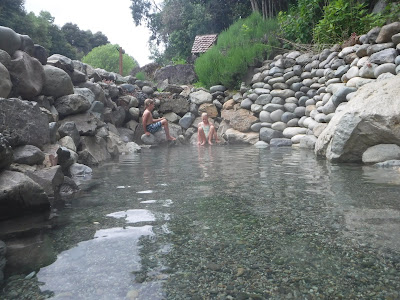


Termes Pazones was definitely rustic in that there were only a few change rooms and some shelves for our belongings. All the pools were made of stones with a couple of railings leading into the water. Some might find the facility very basic, but we thought that it was beautiful. Being in a place away from the glitz and glamour really help you feel the natural beauty Mother Nature has to offer.


We went to the Termes Pazones on a rainy day which made it extra special. The water from the pools was steamy and the cool rain fell gently cooling us down at the same time. It was magical!


2. Rafting
Pucón is known for adventurous activities and one of these activities is rafting! David and I have each gone rafting before, but not the kids. We love travelling by canoe, but never have we as a family been on white water so I was wondering how the kids would handle it! Since it was still spring, the water was still high and pretty cold (though I am not sure how much warmer the river ever really gets), so we were happy to get full wetsuits (even the boots)! After getting dressed we learned a few commands and hit the water. The most important safety tip that the kids learned was how to brace their feet in the boat so they wouldn’t be bounced out.


Before long, we were on the rapids and being bumped up and down while being ordered to paddle and stop paddling, and celebrating by giving each other high fives in the air with our paddles. The kids had a great time! There was even a conversation as to which was better; Splash Mountain at Disney World, or the rafting.


At one point the river slowed and the guide suggested that we all jump in and enjoy the river...not a chance said the Havixbecks! It’s great to be adventurous but it is also good to know your limits! Adeline’s hands were already so cold they were numb, and with my allergy to the cold, we all decided to pass! Maybe another time.

After about 5 rapids and 45 minutes later, our ride was over. Definitely a great way to spend a day in nature in Chile!

3. Climbing up Volcan Villarrica
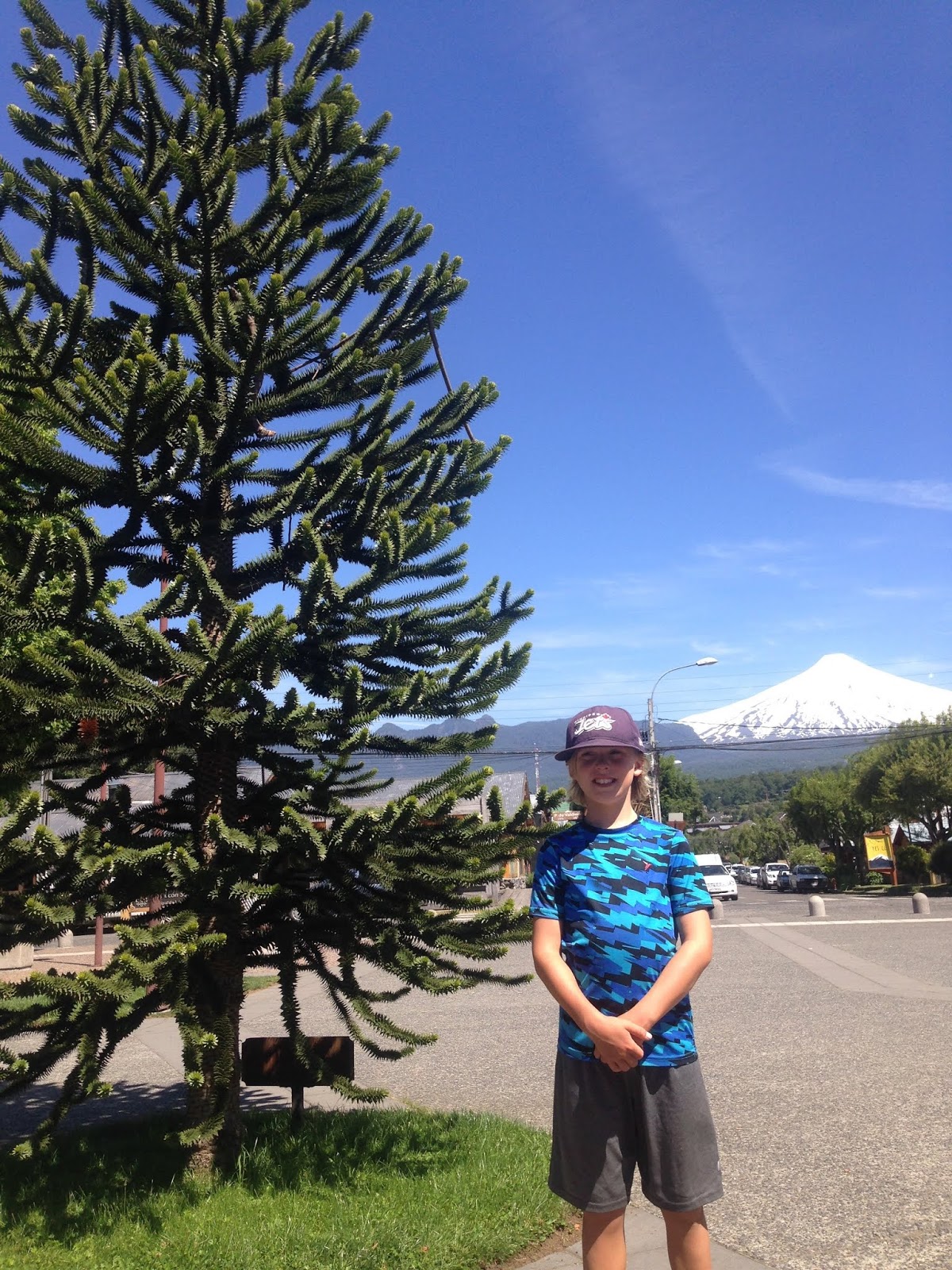
When you step out of the bus in Pucón, you can’t miss the beautiful Volcan Villarrica! It is just there looking beautiful. Everywhere you go in town, as you cross intersections, as you pass breaks in the houses and buildings, it’s there.
A beautiful view of Volcan Villarrica. 
Climbing this beautiful volcano is another popular activity for tourists here. Knowing that Charlie is a great hiker and loves hiking, we thought we would try and find a company that would allow him to come along too. We haven’t seen too many families travelling with children, and it is pretty rare for families to bring children on extreme activities such as hiking volcanoes, but we knew that Charlie could do it. After visiting a couple of agencies, we found one that would allow Charlie to come. Adeline ended up staying back at the hostel with one of the volunteers we got to know. They spent the day at the beach and eating ice cream!

For David, Charlie and I, the day began very early! We were picked up at 6:00 am from the hostel and were taken to the office where were geared up! Helmets, ice axes, coats, mitts, hiking boots, crampons, gas masks and sleds! We were also instructed to put on lots of sunscreen and pack snacks and water. Soon we were on our way.

At the base of the volcano, we were given a choice to take a ski lift part of the way up (and to cut about an hour off of our hike). We didn’t think that we would need to do this, but the guides strongly suggested that Charlie (and at least one parent) take the chairlift up, so Charlie and I went up with a guide. We were under the impression that once we arrived at the top of the ski lift, we would wait for the rest of the group before continuing (otherwise David would have come with us too), but instead, the guide that went with us decided to get a head start and expected the rest of the group (and David) to slowly catch up...but unfortunately this never happened. Charlie is such a champion hiker that he plowed right up the cone of the volcano and Charlie and I summited well before the rest of the group!


First time on Crampons!

Charlie rocked it up the volcano!
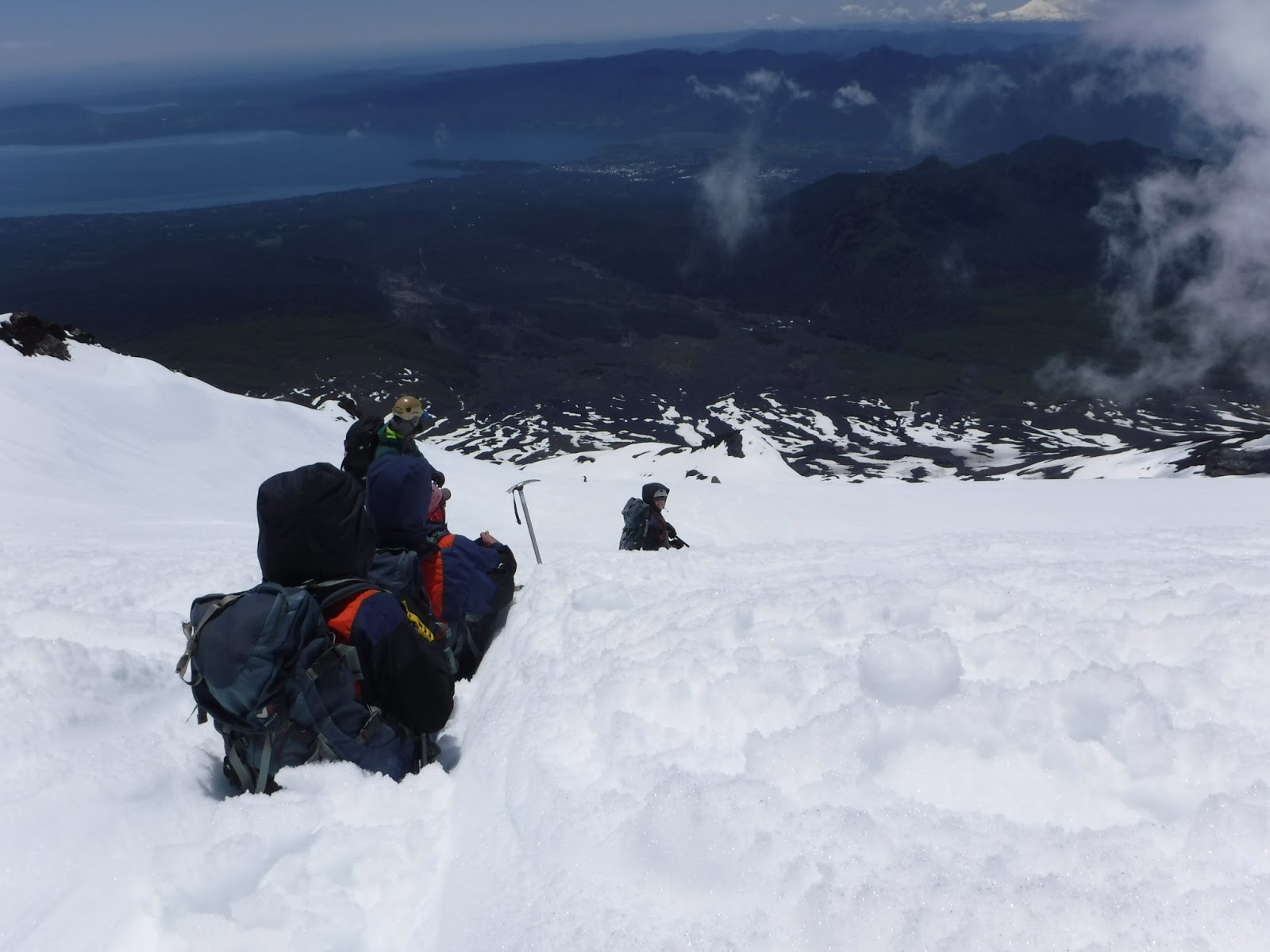
The higher we climbed, the more exciting the climb became, and the better the views! Near the top, we were climbing on a glacier and the snow became quite a bit harder and a little more slick which made us grateful to have the crampons and ice axes! We occasionally took breaks for a little snack and a some water, but to stop we needed a safe place to rest, so we had to dig some holes into the snow to sit in because the slope was quite steep.  


Digging a place to sit. 
We were lucky that we climbed the day that we did. Aently the previous was so windy that the guide had to build a shelter to protect the hikers from the wind each time they stopped, or else they would likely be blown over and perhaps injured. But we never stopped long. Charlie was always ready to keep going.


Hanging out by the glacier on the way to the top!
Just below the top, we dug some holes for our bags, took out our gas masks and headed to the crater. Villarrica is an active volcano and toxic gas is always being emitted, so it was very important to be wearing the gas mask. But even with it on, and wearing sunglasses, it made our eyes water, and we could still smell the terrible gases. Just before reaching the top, Villarrica grunted and shot out some small rocks at Charlie and I. We had to turn away to avoid getting a face full of rock. They were small rocks, but quite sharp. When we tried to pick them up, they were still slightly warm to the touch and crumbled easily in our hands.


Looking down at the crater of Volcan Villarrica!
Soon the rest of the group caught up. It was nice for everyone to be together again! While exploring the top, the volcano growled a few times, which was a bit shocking at first. For people who have never been at the top of an active volcano before, we were not sure if that meant the volcano was becoming more active, and if we should be worried. But the guide did not seem to be concerned, so neither were we.

After soaking in some amazing views, it was time to descend! We had to take off our crampons, put on some gaters and ski pants and then an extra protective layer which the guides were calling our diaper! The last piece of equipment we attached was a small plastic sled. To get down the volcano, we had to slide down!!


Sliding down the volcano!
Dragging our ice axes in the snow behind us to control speed, we slid down the volcano. Sometimes with great control, but most of the time not. If you were near the end of the line, the previous sliders may have naturally created a few bumps in the path which was the unfortunate case for David. On our second slide down, he hit a bump and probably fractured his tail bone on the impact. 


David had to be creative to get down all of the slides.
The remaining slides were a bit of a challenge in that he not only had to think about controlling his speed and direction, but had to find a way not to be on his tailbone either. Luckily, the further we descended, the warmer the snow became and the slower we were sliding.
When we got to the bottom, Charlie took advantage of the sticky snow and made a snowman! Even with missing winter this year, we still got a chance to play with snow!


Happy to make a snowman since we missed our winter this year!
It took a little while to recover from the hike. Hiking in someone else’s hiking boots was the hardest for me. My heals were rubbed raw and toes were achy. All of us had sunburns. We applied sunscreen a couple of times on the hike, but the reflection from the snow was pretty powerful. And poor David still has a sore tailbone, that is not likely to recover for another few months. But it was an adventure I am glad that we were able to do, and will be one of the most memorable adventures from the trip for sure!

4. Puesco Fest
After a day of physical exertion and adventure, a day at Puesco Fest was just what we needed. For the readers from Winnipeg, it is a lot like a smaller Folkfest. People camp out, or come for the day, and chill by the river, play with the circus art activities (juggling, aerial silks, slack lines), or participating in the many small workshops they offered (yoga, Afro dance, etc). There was a stage set up for live music, unfortunately there were only sound checks while we were there.


Another name for the festival is the Free River Festival, as there is also a white water kayaking competition. Our rafting guide from a few days previous was participating in the competition. We didn’t get to see him, but hopefully he did well!


Charlie spent the day working on his devil stick skills, Adeline played with some girls on the aerial silks, and David and I mostly just sat back and relaxed and enjoyed the environment.


For people that are familiar with these type of festivals, you will know that toileting can take some organizing. Back at home there would be row upon row of outhouses, but a festival like this has a strong focus on having the smallest impact on Mother Nature so it had dry composting toilets and “Pee She’s”, which was basically a small urinal made of sheet metal that would accommodate both girls (who can squat) and boys, with a wooden divider to allow some privacy. There was a bit of a splash factor, but I love the idea! All the pee just drained onto the ground below, so there could have been a smell factor later in the festival, but it wasn’t a problem while we were there at all.

Another fun part for Charlie and Adeline was that many people brought their dogs. We’ve noticed that in South America, rules and etiquette regarding dogs is a bit different. There are fewer people having their dogs on leashes and really they  just let them wander about. I have seen people just letting their dogs out like they would let a cat out, the dog goes about its business exploring the neighbourhood, sniffing out some food scraps, having a little fun with other dogs (and maybe a few people) and then heading back home. This was no different at Puesco fest. There were several dogs, just being dogs which was great for Charlie and Adeline who joined in the puppy dog fun, running and chasing each other. It was definitely a great day. A perfect way to recover from the challenge of the day before.

5. Ojos del Caburgua and Ziplining
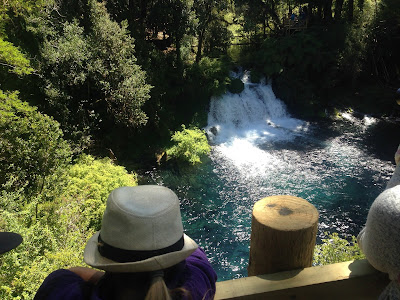
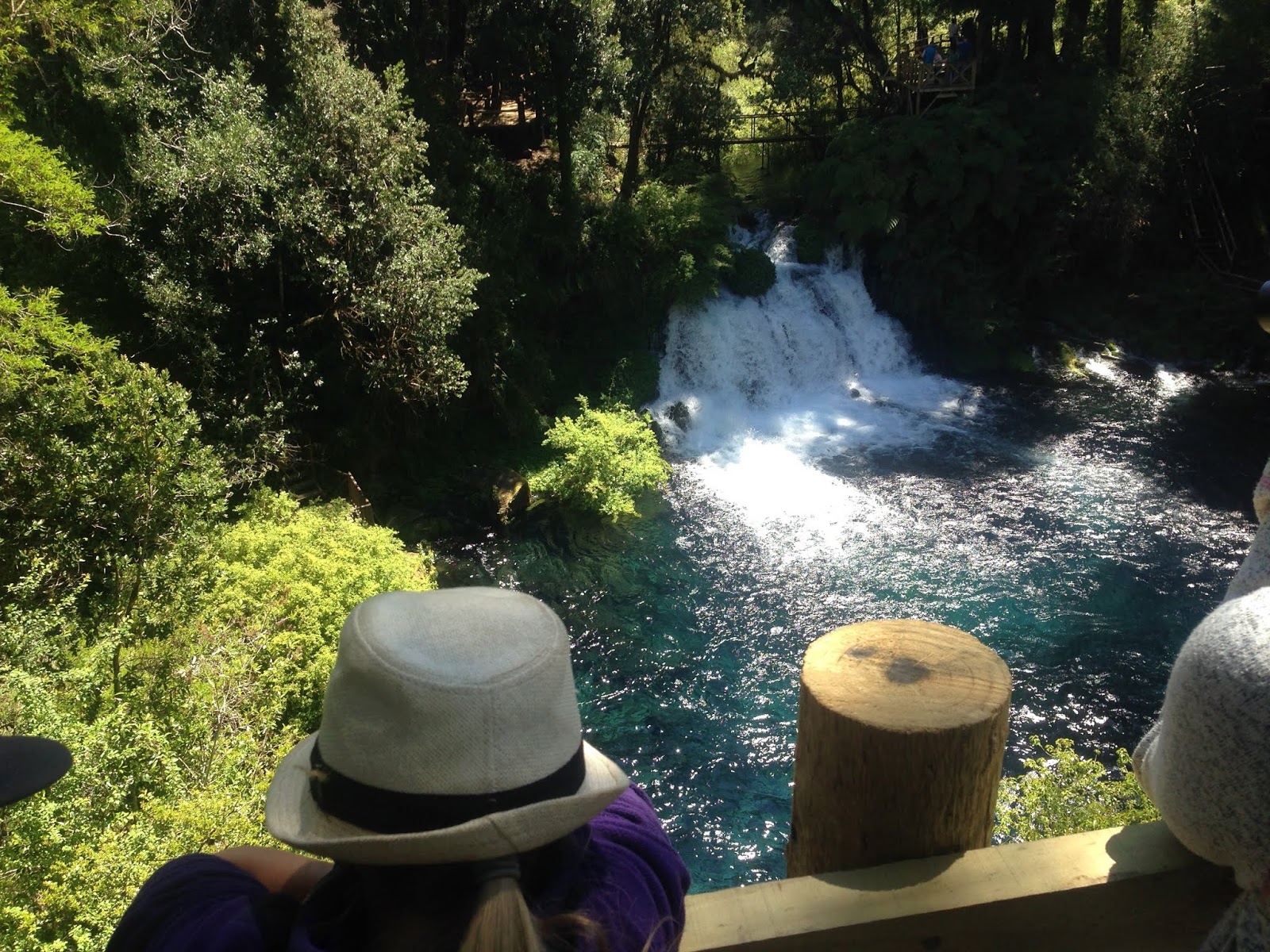
Pucón is known for its outdoor adventures, but none of the adventures actually take place in Pucón, but everything is a relatively short ride away. Wanting another day out in the great outdoors, we hopped on a bus to head to Lago Caburgua (a pretty lake with a white sand beach). We knew that there was an interesting site along the way called the Ojos del Caburgua, so we hopped off the bus to have a look, which ended up being a very pretty (and very short) walk to two beautiful pools of water being fed by two separate water falls.


Adeline was pumped when she saw the ziplining, which in Chile they call “Canopy”. Since she did not get to have the adventure on Volcan Villarrica with us, we thought she should get a chance to have an adventure too, so Adeline, Charlie and I went ziplining! There were nine zips and it was a lot of fun! Some of the pathways were really close to the trees and it really looked like there wouldn’t be enough room to clear them, but alas, we made it unscathed, but bursting with excitement and enjoyment!


We had such a great time at the Ojos, that we didn’t even bother to continue on to Lago Caburgua, we just took our time and went back to Pucón to enjoy the rest of the day.

6. Parque Huerquehue


Our last adventure based out of Pucón was hiking through the Huerquehue National Park. It was a beautiful hike through forests of various trees. From bamboo shoots to huge old trees covered in moss and climbing vines, to the unique Monkey Puzzle trees. 

One of the many Monkey Puzzle Trees in Huerquehue National Park.

A young Monkey Puzzle Tree in the Plaza de Armas in Pucón
It was nice being in tall trees again. It reminded us of hiking on the coast of Vancouver, Canada.


We found lots of old hollowed out trees on our hike!

There were plenty of big trees to play on also!
The hike took us up and down and around several small lakes. Past two beautiful waterfalls and finally to Lago Verde where we stopped and played near the waters edge that was home to an abundance of small lizards!


Taking a break at Lago Verde

It felt good to get back into the wilderness with beautiful trees!

Wednesday, 2 January 2019

Pichilemu, Chile

After visiting wine country, we headed back to the coast to a town called Pichilemu, which is known for its surfing. Charlie and Adeline have each tried surfing once before, when we were in Hawaii, but they were very gentle waves compared to what you can find in Pichilemu.


We found a place on Airbnb and the host was so kind to arrange surfing lessons for us the next day….kind of. He picked us up from the house and took us to town where he did some negotiating with a local surf shop. In the end, we paid him and he gave us some snacks, so perhaps he was making his own business deal with the surf shop.

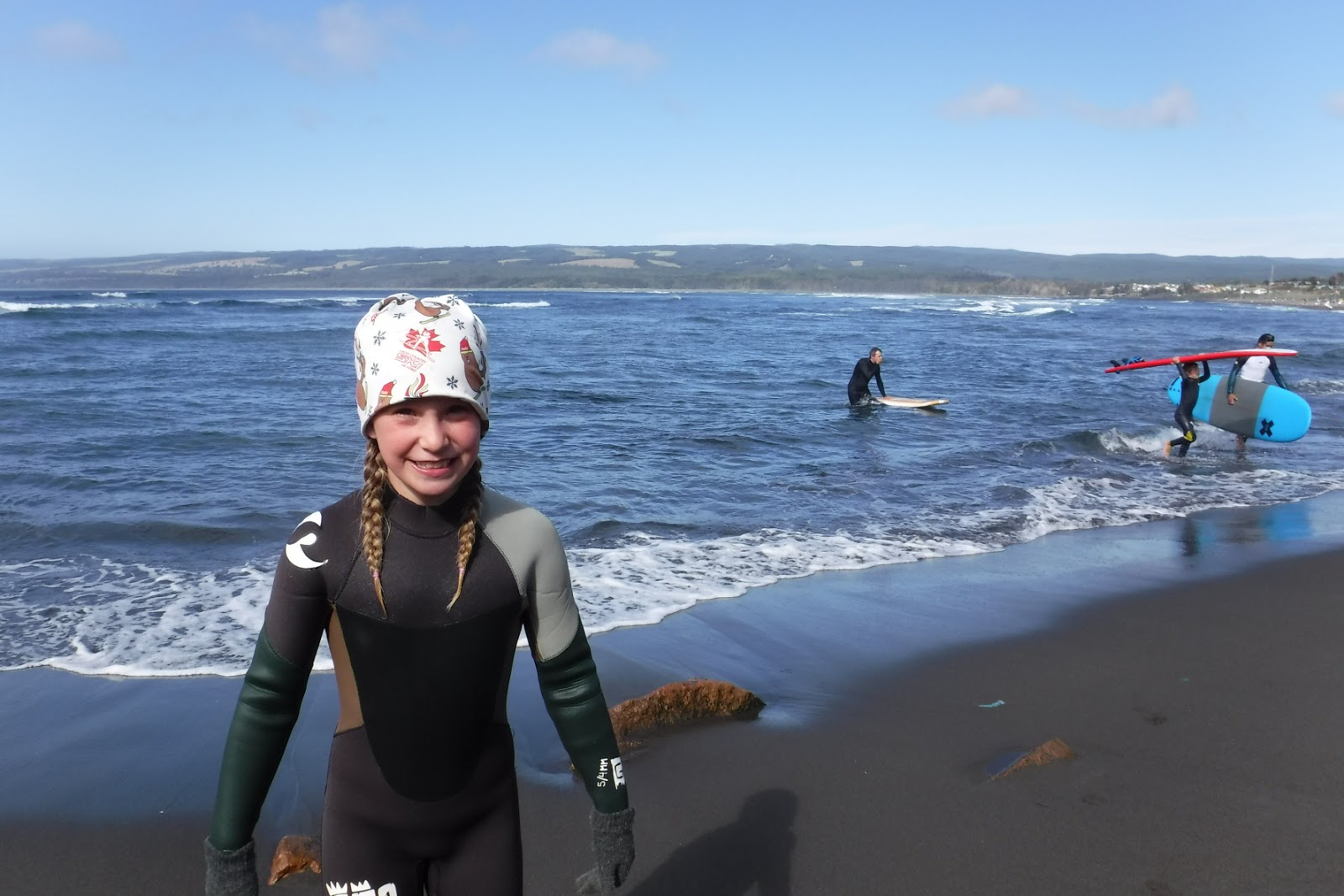
The Humboldt Current, which runs along the coast of Chile, is very cold and it wasn’t summer yet, so we were unsure how the kids would do in the cold water, but David and the kids were given wetsuits and everyone did fine in the water. I didn’t surf and decided to be the photographer instead.


After a little bit of instruction, a little bit of practice on land, and some stretching, everyone got into the water to catch some waves! I even waded out (without a wetsuit - brr). After snapping a few shots, and when I lost feeling in my legs, I headed back to shore. The black sand beaches helped warm me up quickly! After about an hour of fun in the waves, everyone headed in.


We were staying outside of town, which meant that there wasn’t a lot going on around us. There weren’t many restaurants or many stores, but there was a beach! This wasn’t a very good beach for surfing or swimming, but it was a great beach for exploring! Another black sand beach was hot on the feet, so it was important to stay very close to the water to cool down, but this is also where treasures are found! The kids were excited to collect shells and play in the water that was trapped in the rocks. One time Charlie found a giant pearl...or so he thought! Turns out it was a marble, but it was exciting all the same! We hardly saw anyone else on the beach, so it felt like we had our very own paradise.

We visited the beach at dusk also. At first, we were planning just to go down to watch the sunset, but when we arrived, we found something even better! The once empty beach now contained several people standing patiently by the sea. Upon closer observation, we noticed that they were hunting for crabs! We watched as the people would wait by the side of the water with gloves and a bucket or a bag. Some had special contraptions of picking up the crabs without using their hand. So they would stand by the water, waited for a wave to come in and then scour the sand as the wave was pulled back into the ocean. The hunters would be looking for a small bump or moving legs. It was extremely difficult to see, but these people have trained themselves well. If they noticed the small bump in the sand, they sprinted in, grabbed the crab and run back with their prize! They had to be quick because if another wave came before they picked up the crab, it would be washed back into the ocean.

After a while of watching and cheering on the crab hunters, we remembered that earlier that day, while exploring, we had seen a leather glove on a log, and after a short search we found it again. Now was our chance to give it a try. Charlie and David took turns trying while Adeline and Amanda cheered them on and helped try to spot crabs. We waited and watched and waited and watched, then we spotted it! David dashed in, scooped up the crab and threw it back at us before it could pinch his fingers. It was a cute little crab, about the size of a hand, and he did his best to look intimidating with his claws. We played around with him for a bit then decided to give it to one of the other hunters (because we were leaving the next day). Unfortunately this was probably the first time we forgot to bring a phone or our cameras! But the crab hunting will definitely be one of the most memorable adventures from this trip!

Wednesday, 19 December 2018

Exploring Wine Country in Santa Cruz, Chile


When it is time to buy a bottle of wine, we almost always choose South American wine. It’s relatively inexpensive and it is delicious. As we travelled south through Chile, we had to stop in the central region which is known for its many vineyards. We read through our Lonely Planet guidebook, and researched online, and decided on staying in Santa Cruz. We ended up choosing Santa Cruz because David found a way we could rent bicycles and cycle through “La Ruta del Viña” (The wine route). We decided to stay at a hostel called Casa Suiza where we not only spent our nights, but were also able to rent our bikes. They even went out of their way to obtain a bike the right size for Adeline, since all of their bikes were a little big for her. The bikes were also equipped with locks and paniers which helped store our lunches and snacks on the way to the wineries, and then held our wine on the way back!


Happy to finally be back on bikes! 
Casa Suiza also gave us a map with directions to and around “La Ruta del Viña”. We started out early on a Sunday morning. Everyone was excited to finally be back on bikes! As we followed the bike path that would take us out of town, the path was blocked by the Sunday market! But what a great way to pick up a few more pieces of fruit for our bike trip. 


Soon we were back on our bikes and heading out of town and after a short ride, we turned onto the wine route. With only one small hill, it was a fairly easy ride. We decided to beat the heat and ride all the way to the end of the route and then stop at a few wineries on the way home.


The end of route finished at Viña Neyen one of the oldest wineries in the area. It was also a very expensive winery to visit and since it charged $40 each to try two different wines, it was the only winery we visited. That’s okay. We had a great day riding our bikes past the many vineyards with the tune of “I Heard it Through the Grapevine” playing over and over in our heads. Okay, I may have sung it out loud a few times too.


I heard it through the Grapevine!  
We went to Santa Cruz for the wine, but surprisingly we visited the same time as their beer festival! So, not only did we experience wine country, but wlso got to sample some local craft beers. David and I each found a beer we liked, but Charlie and Adeline loved the live music. Adeline especially liked DJ Hack who played a lot of electronica music while the host pulled kids from the audience to showcase their dance skills for a free slushie. Sadly, we had to leave when a cover band for Guns and Roses came on stage. We found out the next morning that the band’s ‘Axel Rose’ was staying in our hostel. Wow!

Monday, 26 November 2018

The Beginning of our Chilean Adventure

When planning our trip to South America, Chile was number one on our list, but after travelling through Peru and Bolivia, there have been times we have felt like we would like to quickly get through Chile and go back! The cost of living in Chile is significantly higher, so finding affordable accommodation and food has been a bit of a challenge. Instead of comparing the prices to Peru and Bolivia, we have to think about what it would cost back at home. The economic situations of Chile and Canada are likely more similar.

The best part about being in Chile is that there are a lot of beaches! In the long skinny country on the west coast of South America, you have volcanoes and beaches! We have definitely spent our fair share of time at the beach so far, and our favourite beach is at Caleta Portales in Valparaiso. The beach is right next to a fisherman’s market which may sound a little stinky, but makes it very exciting!  While walking to the beach, we couldn’t miss the flocks of pelicans waiting patiently near the market. They were waiting on the pavement next to the man cleaning the fish, on the roof of the fish market, and on top of large shipping containers stacked nearby. We watched as the fisherman tossed the remains of the fish to the pelicans. It was like spectators waiting for a ball being hit into the stands at a baseball game; once the scraps were thrown to them, pop, one pelican would grab it out of the air! There were no big struggles on the ground but there were still bossy seagulls hanging around waiting for any scraps they could find.


Birds weren’t the only scavengers waiting for free meals. Out in the water, next to the piers, sea lions were on constant alert for a fisherman walking with a bucket, which meant feeding time! And when it wasn’t feeding time, they would just lounge in the sun on the beach or play in the waves. The kids had a great time watching the sea lions swim back and forth and up onto the beach. Sometimes, the kids found fish scraps on the beach and threw them to the sea lions. And to think that we paid for a tour to see them lounging on the rocks off the coast in Peru. This is a much more exciting hands-on experience!

Being from a flat land far away from oceans, the power of the waves at the beaches has been very exciting for us! At first, I was very worried about the children and their swimming skills around the riptides, but it has become clear that so far it really isn’t too much of a problem. I have gone from telling the kids to ‘only go in as far as your ankles’ (be super careful), to ‘go in as far as your knees’ (be careful), to ‘go in as far as your waist’ (have fun and watch out), to ‘jump in! Dive in!’ But, it is pretty cold in the Pacific Ocean here, so the kids tend to play a bit in the water but frequently need to warm up in the sand!

David witnessed something pretty neat at the beach one day. After some research online he found one website that called it the “Argentinian Clap”, but since we are in Chile, perhaps it should be called the “South American Clap”. David heard many people nearby begin to clap in unison. This, of course, drew his attention. It turned out that a child was lost and the clapping was meant to get the attention of the parent that was missing a child. As the lost child was carried along, the clap moved down the beach with them. It was really neat seeing the community work together!

We were in Valparaiso for about 10 days and we went to the beach every day. We also made a quick stop in Pichilemu, which is known for its great surfing. David, Charlie and Adeline had a lesson one day and braved the cold water for some fun in the waves, but one of the most interesting parts of our visit in Pichilemu was another discovery by David.


\There was a beach very close to our accommodation (just south of Pichilemu) that, during the day, seemed practically deserted. It wasn’t the beach where we would surf, but it was a great beach for exploring. A black sand beach with very fine sand and we could find shells amongst the pools of water trapped but large volcanic rocks. While it seemed deserted in the day, more people came to the beach when the sun started to set. We went down to the beach to watch the sunset, but all the other people came to the beach to hunt for crabs!

As the sun was setting, you could see the silhouettes of crab hunters standing at the edge of the water in the mist of the salty water. They would walk to the rhythm of the waves; backwards while the waves came in, and forwards when the waves went out. And once in a while, when the waves went out, one might see a little bump in the sand. A crab! And the crab hunter would suddenly burst into a sprint and grab the crab with a gloved hand and put it in their pail waiting on shore. They had to be quick, because if another wave came before they grabbed the crab, it would be gone for good!

When we were exploring the beach earlier in the day, we saw a glove sitting on a rock, so we walked back to that rock, and it was still there! So we took the glove and tried some crab hunting ourselves. Some of the crab hunters let us try picking up one of their crabs from their bucket, and after feeling the power of their claws, Adeline let David and Charlie do the hunting for our family. It took an immense amount patience and concentration to wait for a crab to finally be swept up with a wave, and as the sun set further down and then below the horizon, it was harder and harder to see the crabs. The boys worked hard as the girls cheered from the shore, and then it happened. David saw the crab and after a mad dash, he was able to grab the crab and throw it back to shore! After playing with the crab for a little bit, we decided to give it to one of the crab hunters and head home to bed!

That might just be the last of the Chilean beaches on the ocean for a while, because we are now going to head inwards towards the Lakes Region!

Sunday, 11 November 2018

Adventures in Bolivia


Before visiting Bolivia, all we knew was that Bolivia was a relatively poor country compared to Canada and that it was rich in superstition. After leaving Bolivia, I wish that we planned to stay longer because it was relatively cheap living, beautiful and it never ceased to surprise us with its diversity of traditions and modern developments.

We decided to use the company Bolivia Hop to get from Cusco, Peru to Copacabana, Bolivia (and eventually to La Paz). It was nice using this company because there is an English speaking guide who can explain the ins and outs of the country and what was happening at each of our stops. It was another night bus, and after riding the extremely comfortable Cruz Del Sur, this was not a fun ride. The seats did not recline very far, and it was very difficult to find a comfortable position. Travelling tired, with tired children is not the funnest experience...

1. Copacabana
Our first stop in Bolivia was Copacabana, a small town on Lake Titicaca. We only stayed for one night, but looking back, we probably would have enjoyed a few more days. One of the first things we noticed were the cars! Many of the cars were decorated with flowers and streamers. It seemed as though there was a festival they were decorating for, but through a little research we found that people like to bless their cars for good luck (for safe travels and no accidents). As we walked around the small town, we came to the Plaza 2 de febrero (main square) and were surprised to see line ups of cars and vans, two by two, getting decorated. There were also many stalls selling flowers (real and fake), small religious figures to attach on the outside and inside of cars, streamers and other colourful decorations. And to top it off, they also sold champagne and Coke that I believe, though we never witnessed it, they spray on cars. It seemed like quite the long process because we watched a van being decorated for over 30 minutes and it seemed like they were still adding touches when we left.


Another adventure for us in Copacabana was climbing Cerro Calvario, a tall hill right next to the city. While walking to the hill we saw a sign that read “Cerro Calvario” and pointed to a beaten path going upward, so one would think that it was the proper route up the hill. It was a challenging and rough climb up, and at times, we weren’t quite sure if we were on the path or not, but if we just looked upwards we could easily see which way we needed to go. Sometimes we saw people coming down the hill which confirmed that we must be on the right path! The top had a beautiful view of the land around and it was dedicated to the Stations of the Cross. As we walked across the top of the hill, we found…..the real pathway up the hill! A pathway constructed by bricks and stones with gradual steps zigzagging down. While this would have been a much easier climb, Adeline noted that the other way was much more interesting and fun!


Copacabana was a great place to visit because of the lake life for the kids. Being near the water and having a sandy beach to play in was so relaxing. Water and sand are definitely the two best ingredients for a family trip! Those two ingredients can entertain a child (and an adult) for hours on end! And, we got to have fresh trout for dinner! If you read our previous post about the Uros Islands, you would have read that the trout was introduced from North America and is now an invasive species in Lake Titicaca, so we didn’t feel badly when we each had our own fish for dinner.


2. La Paz
Back on the bus and off to La Paz, the highest capital city in the world (kind of...Sucre is really the capital of Bolivia, but only in name. The government sits in La Paz). La Paz is very neat in that it is shaped like a bowl; high mountain sides and city down in the bottom of the dish!

We arrived late at night and this was why I was most grateful we had chosen to ride with Bolivia Hop. Big cities can be a bit intimidating when you first arrive, but big cities in a country where you cannot communicate and have no access to a phone or the internet can be extremely intimidating! Our guide made sure that everyone on the bus made it to their hostels. When it was our turn, he jumped off the bus, took us right to the door and rang the bell because the door was locked. Nobody answered for 5 minutes… 10 minutes.... He kept pressing the bell and he even ended up calling a number he found by spying through a window. Finally after about 15 minutes, our host came to let us in. If we hadn’t had our guide, that situation would have been pretty disastrous! We slept in pretty late the next day!

Our first real day in La Paz was Sunday, and it is a good thing we arrived when we did! La Paz is bustling with activities for kids and families on weekends! After reading blog posts and websites written by other families, we found that one of the main roads, Prada Boulevard, had a festival for children. Unfortunately we woke up so late that I think that we missed most of it, but we still had a chance to see some street performers. If you haven’t seen our Instagram post of the rocking skeleton puppets, you should have a look! 

I was pretty disappointed in missing the children’s events, but as we stopped to figure out what to do next, we heard music and followed our ears, which ended up taking us to their Central Park. Wowee! What a Central Park they have in La Paz! We saw two separate fairs with carnival rides, a music stand where a band was playing cover songs from bands such as Green Day and Guns and Roses, a big BBQ cooking up pigs, and street vendors with all sorts of goodies! There also seemed to be a soccer tournament going on in the soccer fields in the park and we also saw people lined up outside their open air theatre for some other event going on! 

After eating some lunch and taking a ride on the Ferris Wheel, we decided to just keep walking to see what we could see and soon we found ourselves on a huge boardwalk, about a kilometre long, that took us high above the streets all the way to Pipiripi (La Paz’s Children’s museum). It cost us about $5 (Canadian) for the whole family to ride up their funicular and explore the museum for the rest of the day. There were science themes, lots of hands on fun and a focus on reusing materials for play. We could easily have spent another couple of days there, and it would be easy to afford since it was only about $5 for a family of 4!


The next day we spent on the Mi Teleférico (the world’s largest and highest aerial cable car urban transit system). There are several lines connecting the city and we just rode line to line. It was a fun way to see a bird’s eye view of the city! Sometimes we would leave the station, have a play in a local park, and get back on again. This also was a very inexpensive activity. About $5 Canadian for the whole family. Mi Teleférico is highly recommended by Charlie and Adeline!


3.Coroico
As exciting and fun as La Paz was, it is always nice to get away from the big cities! We wanted to find a place to just kick back and relax for a while, so we headed on a minibus to Coroico, a small town about 3 hours out and down from La Paz. And goodness, the drive was one of the most memorable drives I have ever been on. Being driven in a minibus in Bolivia is an experience in itself. People do not wear seatbelts (sorry mom), kids sit on laps of parents in the front (not us, don’t worry mom), there are lines on the roads, but the drivers don’t always follow them. The roads aren’t always in great condition...but that is how we were going to get to Coroico (Even the Bolivian man sitting next to David crossed himself once. If he was scared, should we be?). The drive to Coroico was once along the “Most Dangerous Road in the World”, but a new, paved road has been made. Many tourists ride the old road on mountain bikes, but we decided against it (you’re welcome mom), partially because there weren’t bikes that would fit Charlie and Adeline. And the clouds...wow! We drove through a cloud forest (a valley where clouds are trapped) and we were just amazed at the sights (or lack thereof) the whole way down! Our hostel was on the side of the mountain, so throughout the day, we had impressive views of the cloudy valley below and the mountains peeking above!

Math class with a beautiful view at our hostel.
From Coroico, we were able to visit La Senda Verde, a wildlife sanctuary that was once an eco-lodge. People kept dropping off injured animals, or animals that were illegally taken and sold as pets, and now they have a sanctuary full of animals from parakeets to monkeys to caimans. This might just be one of Adeline and Charlie’s favourite places so far. Move over Disney World! 


The bridge to Sende Verde (only two people allowed on the bridge at a time!)
We had a guide take us through the sanctuary, but first we had to go to the restaurant and take everything of value out of our pockets because the local capuchin monkeys like to go through pockets and have been known to rip up money or run off with it! We got to observe all the different animals that they care for while walking through a chain link cage for the humans. It was funny being the ones in the cage. We will remember the caiman enclosure the best because that is where a curious capuchin came to investigate Charlie and Adeline. We had to leave the human cage to see the caiman enclosure, and that is where the capuchin spotted us. It walked overtop of the roof and jumped right on Charlie’s shoulder, immediately peeled off the sticker on his hat, undid the Velcro and zipper on his raincoat and started exploring! What a monkey! Then he saw Adeline, reached over and knocked her hat off, climbed on her back and sat there until our guide took it off, then back to Charlie again. We had to leave the enclosure because it wouldn’t leave Charlie and Adeline (which was hilarious and exciting for us, but the staff didn’t think that it was so great as this was a wild monkey).


We had a little bit of time to sit and wait while a cab was called for us to go back to Coroico. While we waited, we sat with Maruca, the grandma spider monkey who likes to cuddle. Maruca is the only ‘wild’ animal allowed in the human cage. Maruca has a sad story. She was bought by a woman who abused her. She was hit frequently, which is obvious by her broken nose and misaligned jaw. Apparently one time she fought back and bit the lady, who ended up punishing her by pulling out some of her teeth! Thankfully she now has a home where she can relax and live in peace with only the occasional argument with the dog. If you sit down, Maruca will come over and sit and cuddle right in your lap. She is known as the grandma because she is 27 years old and most spider monkeys only live to 20 years old. I am so thankful that there is a place for her and other animals in her situation.


4. Uyuni Salt Flats
After our time in Coroico, we went on a tour to the Uyuni Salt Flats, a tour of amazingly different terrains and flamingos in the wild!  Nothing can prepare you for the Salt Flats and my words will never be able to describe the incredible feeling of being somewhere completely different, like being on a different planet. At times it reminded us of home, the white landscape was like snowy fields around Winnipeg, but it was hot! And the way the salt flats create almost pentagon shapes everywhere, like an enormous salt tapestry, is incredible. 

Many people like to take photos here that play with perspective. We took our fair share of photos too. You can see them on our Instagram feeds: @greatbigfamilyadventure and @vida_sabatica. Our guide was practically a professional photographer. He lined us up and told us what to do and took most of the pictures.


One of the most exciting parts of this tour was that there was a lot of open space around us, so we could play with our ball and frisbee. Most places in Bolivia and Peru did not have parks or open spaces to play (at least not where we were), and so this was such a treat! There were times where we had a chance to explore an old island or go on a short tour, but really, the kids just wanted to play. So we did.

The second day was spent moving from lagoon to lagoon where there were flamingos! I actually had never thought about where flamingos live in the wild, but here they were! Flamingos were not the only animals we saw. We got to stop in a valley and walk amongst llamas, were visited by some viscachas (relatives of chinchillas) at lunch and we also spotted an Andean ostrich with its baby chicks. Who knew, ostriches in Bolivia? The other exciting part of the day was exploring the rocks! It is very windy in the Atacama desert, and many of the old volcanic rocks have been eroded by the wind into fantastic shapes. One of the tourist destinations is to the Rock Tree where there is a rock, you guessed it, shaped like a tree. But along the way there, I saw other rocks shaped in a similar way, and right next to the rock tree, were amazing rocks that the kids and David enjoyed climbing. And they weren’t the only people climbing the rocks. It is a wonder that there isn’t a climbing company taking advantage of this space, or even the companies using that as a draw on their tours...maybe soon…


The last day was simply being taken to the Bolivian-Chilean border, which was humorous because Bolivia is considered a very poor country and Chile is not, and that is very obvious at the border. The Bolivian road up to the border is gravel, and the Chilean is paved with bright yellow lines. The Bolivian building is very simple and run down, and the Chilean building is more modern. The sign for Bolivia looks as though it was made and erected in the 1930s, and the Chilean sign was shiny and new.

We really enjoyed our stay in Bolivia. Looking back, I wish that we had stayed longer. But who knows, maybe we will head back. We still have 6 months to go...

San Blas Islands, Panama

We left Cartagena, Colombia (and South America) on a sailboat called the Amande. It can hold up to 14 passengers, but there were 11 of us...